BLOGS
The Day Time Became Precious
March 2025
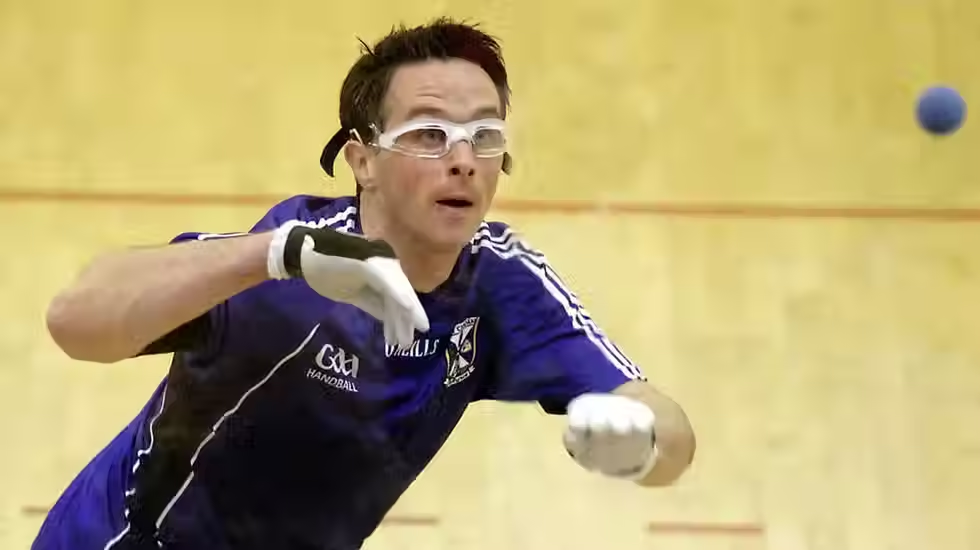
I was twenty-one years old in the summer of 2001 - a young Irish athlete in New York on a summer student visa, spending my days working, training and dreaming about what might be possible in handball and life. I had just finished my undergraduate degree, and just like so many young athletes, I imagined I had all the time in the world.
On the morning of September 11th, my uncle and I were taking the A train down toward Fulton Street. He managed a bar and restaurant called John Street Grill, just around the corner from the Twin Towers, and I planned to leave my bags there, before flying to Chicago to train with various US professional players for ten days.
I’d been preparing for the delayed All-Ireland championships, pushed back until October because of Foot and Mouth disease earlier that year, and Chicago was supposed to be the next step toward a dream I was convinced would last forever.
The Howard Beach platform was quiet - three people in total - when someone mentioned a plane had struck one of the towers. Minutes later, as the subway station grew busier, someone else said the other tower had been hit too. We still thought they were small aircraft. None of us yet understood the scale of what was unfolding.
When we surfaced in Manhattan, another woman told us the Pentagon had been hit. The feeling that morning shifted from curiosity to unease to something far more primal. I asked my uncle if I could quickly drop my bags to his restaurant, knowing I’d be away for over a week. He agreed, and we walked around the corner - just out of sight of the towers.
And then it happened.
A deep, thunderous roar unlike anything I had heard in my life. Instinct took over and I dropped my bags and sprinted into a shoe shop, covering my head. When I reached the back of the store and turned around, I saw a wave of people running past the windows with a massive plume of smoke behind them. My uncle followed moments later, and within minutes the shop filled with people - covered in dust, choking, terrified, unsure whether we were trapped beneath the debris.
For a brief moment, I thought we were going to die.
And in that moment, one thought consumed me: I am getting out of here. I need to get home. I want to survive.
When the dust finally settled enough to see outside, we emerged into a transformed world. We were covered in debris; my throat felt like it had hardened.
I tried again to leave my bags in my uncle’s restaurant - everything I owned was in them - but the ground-floor vendor had locked up and shouted at us to “get the f*** outta here” as he ran off.
So we carried everything and started walking through the Manhattan chaos that I still struggle to put into words.
People crying. People praying. People running with no idea where to go.
And all the while, the same thought repeating in my mind:
I have no control over any of this. We could all die at any moment.
We crossed the Brooklyn Bridge, and halfway across we heard another now-familiar roar. The second tower fell in front of us. Bags were dropped. Most people just stared- some screamed yet again. And still - we kept walking.
Hours later, in Williamsburg, a group of strangers drove us out of the city. I’ll never forget their kindness.
I got back to Ireland one week later. But a part of me stayed in NYC that day- on that street corner, in that shop, on that bridge.
In the years that followed, anxiety crept into my life in ways I didn’t initially understand. My first panic attack happened about six weeks later, when I returned to Atlanta, Georgia to fulfil a lifelong ambition of qualifying for the pro handball circuit.
It wasn’t just the memories of that day that left scarring, it was the loss of certainty, the awareness that everything can change in a single moment.
But the experience also sparked something powerful. Not a dramatic “turning point,” but a thread - a repeatedly felt message that shaped decisions throughout my twenties and beyond: Live today. Go with conviction. Chase the things that matter because tomorrow is never guaranteed.
That belief became foundational to my approach as an athlete and, later, to my work in performance psychology.
It taught me:
• Perspective under pressure
• Resilience born from lived experience, not theory
• Calm leadership in chaos
• A commitment to preparation, because control is limited but readiness is not.
It is no exaggeration to say that 9/11 shaped my performance philosophy more than any victory, title, or championship. It gave me an understanding of pressure that no textbook could. It created a personal lens through which I now help athletes and teams face uncertainty, manage fear, harness focus, and perform with purpose.
I survived a day that took nearly 3,000 lives.
And in the aftermath, I learned that survival isn’t just living - it’s choosing how to live. That lesson continues to guide me, in sport and in life.